



I’m writing as an Italian whose heart is bleeding for her nation. I have known of Giorgia Meloni before her rise to fame. I was trying to convince American newspapers to let me interview her, and they turned me down because she wasn’t of enough interest. Barely anyone outside of Italy knew who she was, nor cared to know. I knew she had talent and would succeed. I met her once; she was particularly polite (not something to take for granted nowadays). I didn’t vote for her because I wasn’t fully aligned. But her personality stood out to anyone who knew of her, irrespective of her politics.
Not many are aware that Meloni was bred in the post-fascist movement of the MSI (Movimento Sociale Italiano). She was a militant and at least sympathetic to fascism in her youth. There are videos of her giving out far-right leaflets and talking about that time in history with approval. In Italy, fascism is not stigmatized the way nazism is in Germany, even if our constitution forbids it. It’s mainly seen as a nuisance of nostalgic fanatics who hold no real leverage.
Meloni was born in the outskirts of Rome, anything but a privileged background. She grew up in a broken home without a father figure and talks openly about how her father’s rejection led her to become an overachiever. She worked in nightclubs in her spare time to make ends meet while she focused on her political career. Through perseverance, she became the youngest minister and worked for various right-wing governments before deciding to create her own party, “Brothers of Italy”. The name was inspired by Italy’s national anthem. One can’t help but notice the irony in the first female leader of a party using this slogan. However, Meloni didn’t care that she was a woman. It didn’t factor into her political affiliations or even perceptions of herself or what she stood for. She was vehemently pro-Italy; anything else was mere noise. She was criticized for defending traditional families while not being married and having a child with a rather unsophisticated toyboy. She chose not to respond to the provocations and kept her personal and political lives strictly separate.
She was marginalized and even mocked for a long time in our country. First, because she has a heavy Roman working-class accent that is considered “unbecoming” for women, and she didn’t possess a formal education, which made her somewhat ostracized from elite Italian politics. Second, she was notoriously aggressive, more than any of the men she was dealing with. She was loud, pointing her finger at her opponents while shouting at them in Parliament. This made her disliked by many politicians who felt profoundly challenged by her. That said, she was liked by the people because of her tenacity and how she delivered speeches with passion and conviction, unafraid to touch taboo topics.
Meloni was politically uncompromising in terms of integrity. She was offered various opportunities to form coalitions with opposing liberal parties so she could be part of a government. Unlike other leaders, she refused - to her own detriment at first. She was playing the long game; she saw herself as exclusively right-wing, and that was the only coalition she was willing to accept. Eventually, that intransigent approach bore its fruits. She managed to win a majority vote to form the right-wing coalition, which meant she would be at the helm as Prime Minister in 2022. She enjoyed a large momentum behind her. Meloni stood out as a woman because Italy has a long history of attractive female politicians being afforded opportunities based on their looks, and the prevailing culture is not particularly favorable to female leadership. She was elected based on merit. On the global scale, she became a formidable and charming woman leading a major European country. She started taking care of her appearance and hiring new stylists to look more formal and presidential. Her front-line rallying days were over.
That’s where it started to fall apart. Meloni made a fatal mistake: She believed the battle was over, and she would sustain a reign of at least a decade. She felt no pressure from beneath, no opposing force either from within her coalition or the defunct left-wing opposition. The only pressures she felt were from above, and she caved quickly to them by thinking that by being accommodating, she could convince them to convert to her cause. This is hardly the case. The positions of EU bureaucrats and American neoconservative warmongers only hardened without significant pushback. Perhaps more tragic is that the Italian electorate did not forgive her for becoming a seemingly out-of-touch, ambiguous centrist whose ideology became increasingly elusive. That’s why she lost the recent referendum on constitutional changes. She started backpedaling and contradicting her major positions, trying to appease all sides so her credibility would remain intact with the very forces she had promised to challenge fearlessly.
There’s another element here to take note of: Meloni was suddenly thrust into political power, giving life to her wildest dream she had held since she was a teenager. However, she was an outsider; unaccustomed to “elite extravagance” like Donald Trump, who, despite denouncing those circles during his electoral campaign, marinated in them for most of his life. Suddenly, she felt embraced at red carpet events with other male leaders (literally) falling to their knees and calling her beautiful. This was alien to her in her own country and different than anything she had previously experienced.
She started assuming a ceremonial, almost diplomat-like role. Her social media radically changed from being defined by videos of migrant assaulting women and her calling them “worms” in the captions to her being pictured in high-end political events with filtered, meaningless phrases such as, “We have strengthened bilateral relations with Uganda.” Barely anyone cared, certainly not the people who voted for her. Of course, one must concede that becoming a leader requires a degree of decorum that is fundamentally different from a campaigner appealing to the sentiments of the masses. Still, the change in her personality was too extreme and uprooted from her values not to raise some questions.
It’s important to note why this shift is becoming so concerning for her voters. Italy, like most European countries, is in a dire state, more than many foreigners realise. I know Americans think they have it so hard, and many look to Europe as a successful hybrid economic system. However, the European welfare state system is not something they should look up to today, and I don’t say this as someone who is a capitalist free-marketeer. I say this because its bureaucracy is ossified and is causing stagnation and decline. There is little dynamism or opportunity to create. Europe, at large, is not a central power on the world stage anymore because it’s not a forward-looking continent. One can hardly find cutting-edge technologies or avant-garde ideologies. Its appeal largely rests on its civilizational history and beauty. It’s like an open-air museum where life is slower and more enjoyable. To someone vacationing, that is understandably appealing - but it represents a fundamental problem for the survival of its people.
In Italy, a decent salary is considered to be worth around 2,000 net euros a month, yet unemployment is high, and rents in cities like Milan - the only city that offers real work opportunities - have been reported by the FT to be proportionately higher than in London. This is a staggering finding - a small one-bedroom apartment in a relatively peripheral area of Milan costs around 1,000 euros a month in rent (at least). Mortgages for these same apartments are life-long. Considering rising gas and electricity prices and other costs, that leaves a well-earning person with 500 euros at best for themselves. That is barely enough to afford healthy food and other basic costs of living. Many young Italians still live with their parents into their late 30s, not because they love their mothers as the stereotype goes, but because that’s the only chance they have to save and invest something of what they earn. And their parents offer them the rooms they grew up in, certainly not the once-large family apartment blocks or agricultural homes where couples could envision having children, with more space and the support from their extended families. Individuals who are supposed to build their lives spend this time surviving in a rigged economic system with a housing market that is largely owned by their Boomer parents, who stockpile the remaining resources. It’s worth noting that Italians, despite the baseless caricatures, work longer hours than Germans on average, and Italy is a major net contributor to the EU budget while receiving almost no benefits from Brussels in return.
The rise of feminism is inconsequential to the decline in birthrates, and Italy is a perfect example to illustrate why. As the rule in statistics goes, “Correlation is not causation”. This fixation on feminism largely rests on the need for emotional propaganda from a manosphere culture that profits off gender division. Most couples in Italy cannot afford to have children. They remain in relationships for several years without getting married because they would have to spend their bare savings on an engagement and a wedding, which would leave nothing extra for their children or any other emergency situation. They choose to have maybe one child in their late thirties and struggle to keep things afloat because of the rising costs of living. There are no fertility incentives like France, which has the highest birthrate from natives in Europe, where the government offers egg freezing and assisted reproductive technologies for free. The power of the Catholic Church in Italy is too strong, and right-wing reactionaries (including Meloni) are allergic to these new developments.
Another point to dispel on the idea that feminism is causing a decline in birthrates is that Italian men are anything but feminist. In many cases, they are (besides being stereotypically known as handsome) notorious for their predatory nature. They are aggressive in their pursuit of women, and for this reason, they are particularly appealing to foreign women who are looking for men unapologetic about their romantic desires. As a result, Italy is becoming the new Thailand for foreign women looking for “virile” men. The accusation that feminism has somehow emasculated men, and this is why birthrates are plummeting, is a fantasy. Italy is a tourist destination for women who are looking for masculine men, but who quickly realize these men are not able to commit because they can barely get by.
The other theory that women entering the workforce is the reason for lower birthrates is not just unsupported, but contradicted by the evidence. Italy has the lowest female participation rate in the workforce among all EU countries (only 51 percent of women work, on average). There aren’t many women CEOs; there are barely any new CEOs at all. This map of birthrates in southern Italy (more traditional and feminism-averse) versus northern Italy (more modern and economically prosperous for women) helps illustrate this point.
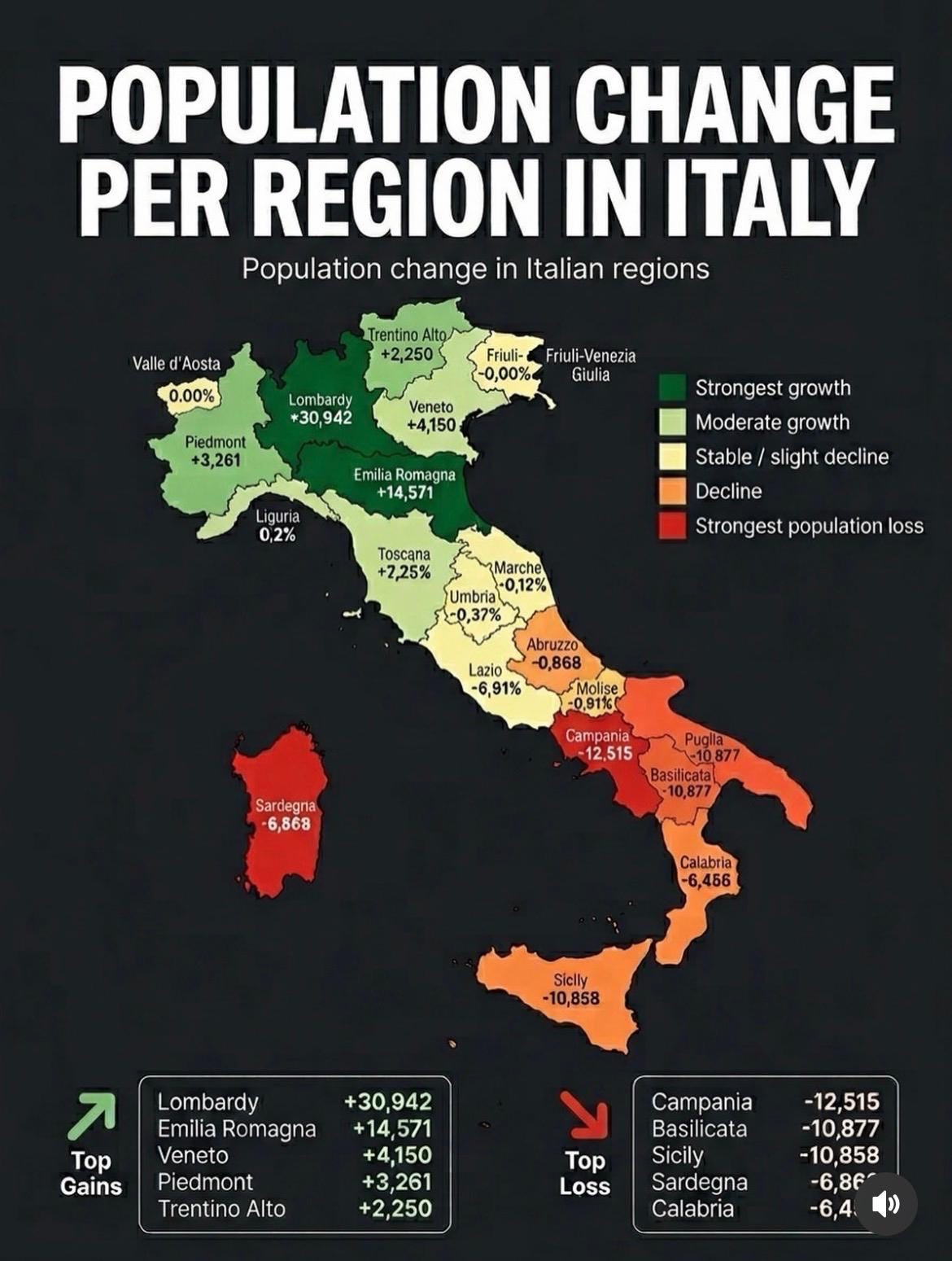
Individuals have families when they can; it’s a primordial instinct for most men and especially for most women. Having children is an inherent joy, but one cannot subtract the cost of children from the equation of when and why individuals decide to have them. If women were financially supported by their spouses, perhaps they would choose not to work and take care of their families. However, that is a distinct argument from claiming that women working is the reason for lower birthrates. The opposite is true in an economy where men can no longer be the primary breadwinners; working women contribute to the income necessary to afford a child in the first place. The idea that women entering the workforce has lowered pay for men is also unsubstantiated. How is that possible in Italy, where almost half of the women do not work? Shouldn’t men, as a result, be earning more?
The reason is simpler, and it lies in the economic infrastructure that defines (and plagues) developed nations. The idea that couples were having more children in dire poverty and war is rooted in a fundamental misunderstanding. Developing and war-torn countries enjoy higher birth rates precisely because children contribute to the family welfare and security. It is not a coincidence that, without exception, all post-industrial countries around the world suffer from this predicament. The structure of the economy becomes inverted: Children become a cost as opposed to a benefit. The fact that Italy lives with the added element of a lack of economic dynamism and opportunity represents an aggravating factor.
Meloni doesn’t understand this, or doesn’t want to. She said her priority was to fix the birthrate and the lack of growth opportunities, but none of her policies since being elected have been directed at family formation or realizing working potential. Italy was known for its strong family foundations and for creating some of the most exceptional ingenuity in history, but this is no longer a reality. It is perhaps ironic that the liberal-Left is more sensitive to the economic predicament of ordinary citizens and recognizes that the “boot-strap” philosophy is limited when trying to redress an issue that requires collaboration through policy changes.
Meloni’s aim was mainly to travel the world to convince countries to invest in Italy, but this would only corrode the nation’s already fragile sense of autonomy and render the Italian economy more captive to foreign interests. Italy produces the strongest quality brands in the world, from its artisanship, designs, scientific developments, and much else. Unlike Western countries that rely on foreign capital or financial bubbles, Italy offers unique, tangible skills, and its economy is solidly based on authentic production.
Her policy objectives should have been threefold. First, halt immigration, which is causing a rise in housing prices and downward pressure on wages for Italian citizens, besides an increase in crime and cultural division. Second, cut down and simplify a bureaucracy that would drive most sane people to a mental breakdown. This is necessary to motivate creation and innovation. Third, invest in the young by enacting policies that require the Boomer generation to give up a proportional percentage of their shares to their descendants so they can afford to build their future and have families in exchange for maintaining their pension benefits. These policies wouldn’t have been a walk in the park to implement; politics hardly is. Nonetheless, countries like Hungary, Poland, and a rise in populism in the West provided Meloni all the support she needed to move forward. She held a majority in government, and many of these economic policies would have been popular among the liberal-Left as well.
There is much more that should be done, but not seizing these basic opportunities ahead of her and choosing a failed realpolitik approach where catering to the EU, the same institution responsible for Europe’s economic and cultural demise, or American neoconservative hawks who are causing instability in neighbouring countries, when Italy cannot afford more influx of migration, is why she lost the referendum. Votes in referendums are rarely about the merits of the choices themselves. They are usually gut reactions on how the electorate feels about the person offering the referendum. She lost, and she is now waking up to the reality that if she fails to redress her shortsightedness, she might lose the privilege the Italian people afforded her. On my part, I hope she welcomes the wake-up call. The majority are still behind her if she chooses to see them. We are waiting for Meloni’s return to her emboldened self.
Alessandra Bocchi is editor of Alata Magazine and artist at Painting Life.
A sharp and honest piece — the kind of writing that doesn't ask for your approval before making its argument. The biographical lens on Meloni is particularly effective; you've made her trajectory do analytical work that most political commentary leaves to abstraction.
One passage stayed with me after finishing: your observation that Italy's economy is grounded in authentic production — artisanship, design, genuine scientific output — rather than foreign capital or financial engineering. That's a thesis worth an essay of its own. The tension between that tangible economic identity and the Brussels-led framework that seems structurally indifferent to it strikes me as one of the more underexplored fault lines in European discourse. I'd read that piece.
Feminism is absolutely a colossal issue: it affects birthrates, social cohesion, attraction between the sexes, wage stagnation, the childcare epidemic, etc. Sex is a polarity - the more alike that men and women become, the less they are attracted to each other.
“This fixation on feminism largely rests on the need for emotional propaganda from a manosphere culture that profits off gender division.”
- Very interesting to say that an ideology that revolves around flattening the genders and inciting animosity between them is not the issue for inflaming gender relations, but rather criticism of IT is.
Women should not aspire to be political leaders any more than men should aspire to be mothers.