


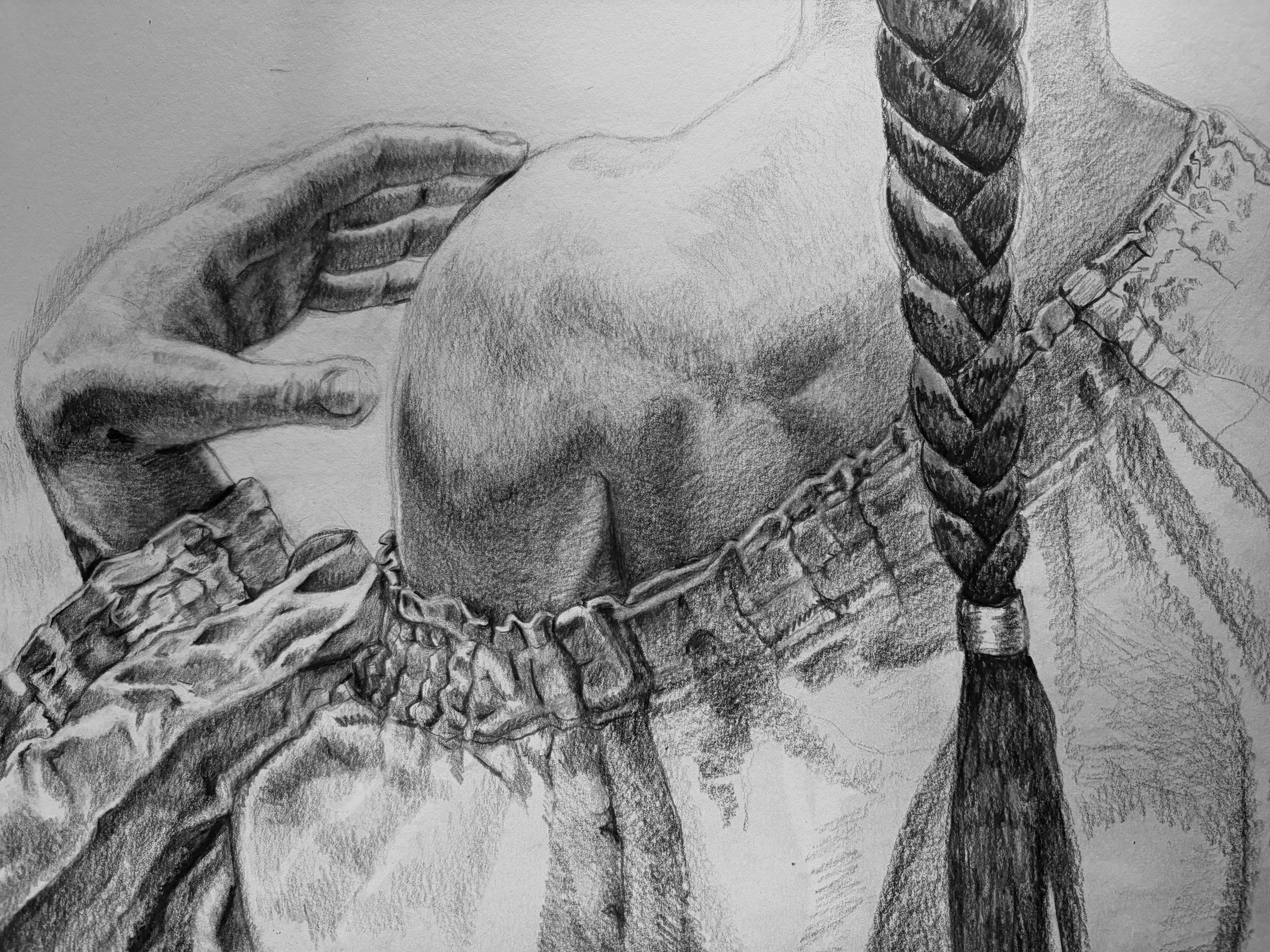
Beneath the loud wars over masculinity, with Democrats recently launching a $20 million “strategic plan” entitled “Speaking with American Men”, are quieter but no less significant battles over femininity. While young men have increasingly reacted with humor and rage against the corralled, tamed world in which their thymotic energy is punished, women have in many ways taken center stage. But what kinds of women, and what stage?
There are two main dominant and insufficient images of femininity today. Firstly there is what we could call “outward femininity,” in which signs and symbols associated with female roles are displayed to the point of parody. This is the pornographic feminine found everywhere from “Trad Wife” videos to the fetishistic behavior of certain men, who find pleasure in imagining themselves being forced to “become” female, and thus degraded. This image of femininity is primarily visual and consumerist and its evident fungibility demonstrates that it has nothing to do with true femininity, which must be predicated on real sex.
The second image of femininity is negative and inherited from the second-wave feminist critique of femininity. Here, femininity is understood as something imposed by society upon girls and women and upheld by them insofar as women have not yet reached sufficient self-awareness to break their shackles. Femininity is understood in this image as a way of being designed by men for men. Take this quote from Germaine Greer’s The Female Eunuch (1970):
The stereotype is the Eternal Feminine. She is the Sexual Object sought by all men, and by all women. She is of neither sex, for she has herself no sex at all. Her value is solely attested by the demand she excites in others. All she must contribute is her existence. She need achieve nothing, for she is the reward of achievement. She need never give positive evidence of her moral character because virtue is assumed from her loveliness, and her passivity. If any man who has no right to her be found with her she will not be punished, for she is morally neuter. The matter is solely one of male rivalry. Innocently, she may drive men to madness and war. The more trouble she can cause, the more her stocks go up, for possession of her means more the more demand she excites.
The eternal feminine stereotype is sexless (a “eunuch” in Greer’s language). She exists solely for others and not for herself, or for other women. Yet even this sexless blank canvas can be the cause of all kinds of trouble because of the rivalry she generates. There is no balance between the sexes in this image, no harmony, no dance. Just men competing with other men over a desirable absence.
While Greer’s account of femininity may be too extreme, after all, pretty girls have inner lives too, it also has the added negative effect of downplaying the need for virtue as such. If all a good-looking woman needs to do is sit there quietly to exude the appearance of virtue, then what point is there in any genuine moral improvement whatsoever? The other aspect of this is the social response, played out over the past fifty years or so, namely, what it actually looks like for women to break with social expectation. The mass entry of middle-class women into the office workforce (though working class women have always worked) played out against a backdrop of technological development that was, in one of those great ironies of history, extremely fortuitous for the weaker sex: namely, the massive outsourcing and diminution of physical labor, the privileging of verbal and social skills in an increasingly data and knowledge-based economy.
It is often remarked that women’s emancipation meant women becoming more “like men”. While there is undoubtedly truth here, not least because male and female spheres became crushed into a single economic space in which men and women compete for work, thus learning each other’s tricks, we have also seen the “becoming-woman” of man. Because of its indirect, non-physical nature, the internet has also seen the adoption of various negative social strategies usually associated with women: Character assassination, mean-girl-ism, and so on.
Both masculinity and femininity are in a confused mess. A couple of years ago, some young Australian women dancing and singing in business suits as “boss girls” were roundly mocked for an office video in which they recite lines like “Gen Z boss and a mini” and “itty bitty titties and a bob”. While the performance was unquestionably cringe-worthy, there was a howl that spoke of a deep pain and a bitter humour: “This is why none of homies have job,” responded one man; “This is why birth rates are declining,” posted another. “Taliban was right”, wrote another.
The world is in desperate need of the balancing of masculine and feminine forces. The meaning of these forces is neither to be found in directly emulating each other, particularly not in grotesque and parodic fashion, this goes for both men and women, nor by accepting the terms of the world as they are currently presented to us. Representation in either the visual or political sense is not the end game for men or women, as if attention or politics were the highest goal.
The recognition of men and women in their fundamental reality must be part of any healthy restoration of both positive masculinity and femininity. To do this we must understand what virtues are shared by both sexes - patience is a good thing to cultivate, but might look different in each sex - and which are specific to men and to women; or, perhaps more subtly, how the same virtue plays out differently in men and women.
To take femininity specifically. We might understand why second-wave feminists were critical of femininity understood as a restrictive social expectation. After all, are there not multiple ways of “being” a woman? For sure, there are. Yet by implying that women should simply take up male values and roles, we end up with a parodic image of masculinity as performed by women. We also dispense with any discussion of the specificity of virtue if we simply imagine that all virtues exist only cynically, that is to say, we have forgotten their purpose, and we become suspicious of anyone who says: “Well, you should behave like this because I say so!” or “Because you’re a woman!” Thus, we end up in a vicious spiral of recrimination and denunciation in which each party wants something from the other, but can’t articulate why.
True femininity is something like this: paying attention to how goodness is natural to being a woman. It is a moral and spiritual question as much as it is a physical or aesthetic one, though they are all connected. Taking up appearance on its own and reducing femininity to signs is insufficient. The girl or woman who in earlier times might have been called a Tomboy does not wish to be a boy or a man, despite the idiotic literalism of our era with gender theory. Instead, she seeks to refuse the gaudy symbols of a hyperfeminity in exchange for a neutrality, which is itself a rather feminine move. The authenticity of the Tomboy consists of a way of being in the world that may or may not accompany interest in typically male-coded things, but this is less the point than a certain kind of effortless ambivalence regarding femininity itself, a refusal to commit to the excessive demands of visual-sexual domination.
While being critical of the excesses of the superficial image of femininity is desirable, chucking it all out in favor of playing the masculine role is insufficient, insofar as it has little to do with the deeper moral and philosophical reality of sexual difference. Femininity is a way of being that enacts a deep sympathy and wisdom. It has as its goal, not the attention of men, though it may well attract this and we hope it will, but rather it consists in a specifically female understanding and intuition of the universe as such, in a way different but compatible with the male vision.
Nina Power is a writer, editor, and philosopher. She is the author of “What Do Men Want?” (Penguin: 2022).

They should have called it “speaking at American men”
We largely compliment each other, each with the important strengths in their respective areas, and should make a point to view this courteously and appreciate the opportunity. Working together is relatively easy, and even fun, when only acknowledging our differences and focusing on the work.