The Right Kind of Cosmetic Surgery
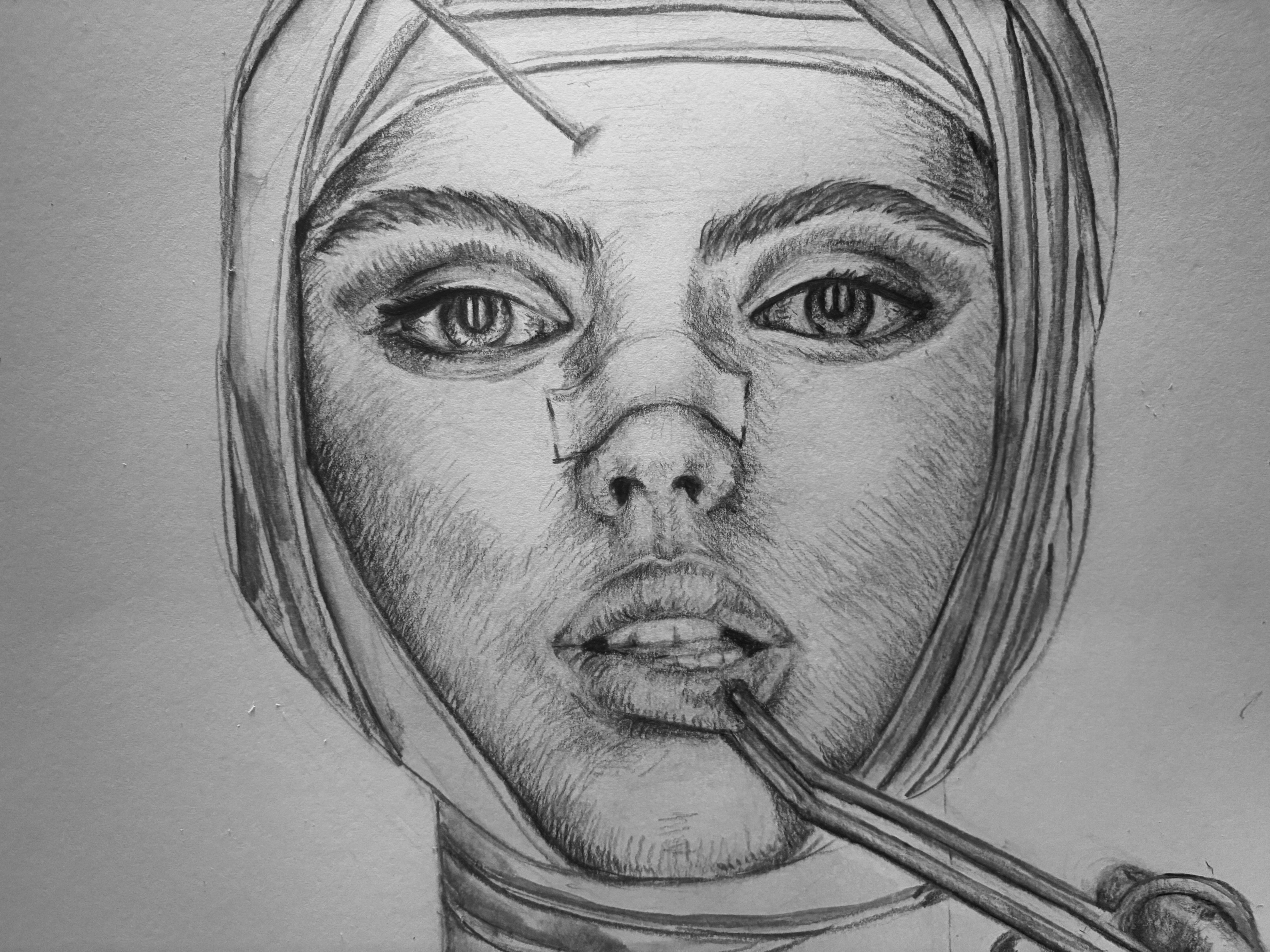
Surgeons as artists
Cosmetic surgery continues to rise. Public figures face the most scrutiny, with before and after photos being analyzed with high-pixel, maximum contrast in the most unflattering depictions possible, often as a subject for mockery. A few times, to show what a great job has been done. Others, to point out how the subject in question is a liar for claiming they’ve had no work done. But in this context, what is becoming increasingly apparent is that the taboo surrounding cosmetic procedures has lost its power. With a 102 percent increase in procedures since 2021 for both men and women (though a case-by-case country evaluation should be made), it’s becoming less of an outlier and a part of regular life. The question is no longer about whether a procedure was done, but how.
I make figurative oil paintings. I made fruit recently, and found that the elements others thought strange - cuts, blemishes, drops - are what gave my paintings life, what made them distinct from a simple illustration. If my fruit were OGM-painted, there would be nothing interesting about it. Likewise, if I made a hyperrealist photographic fruit, it would be equal to a photo. In other words, it would lose its most sacred quality: Imperfection.
Perfection is machine-like. It is not awe-inspiring. Imperfection, on the other hand, creates uniqueness, which is a necessary trait of beauty. It’s a form of imperfection that, unknowingly, can create the image of beauty in our minds.
Another technical lesson I learned through painting faces, in particular, is just how much a fracture of a difference can radically change an expression or structure of a face. One tiny stroke on a nose can change that nose entirely. Adding cheekbones can make the lower part of the face suddenly look disproportionate. Creating bigger lips, even just a single extra line, can create a fish-like look. The harmony of a face is determined by extremely minor, almost imperceptible differences that, however, change the whole entirely. Surgeons are mostly ignorant of this reality because they’re not trained as artists; they’re trained as mechanics. A study reveals that most cosmetic surgeons receive only one anatomy session during the first year of medical school. The same study found that the best surgeons, however, are first and foremost, the best anatomists. In contrast, anatomy is a mandatory, in-depth subject for most students of figurative art.
In our contemporary society, we are exposed to an unprecedented degree of high-quality photography and film. We can easily fall prey to excessive self-consciousness, studying every part of ourselves, comparing ourselves to predetermined definitions of beauty. Industrialization first introduced the idea that perfection, in the sense of strict symmetry and equal parts of a whole without an outlier, equates to beauty. Technology has further exacerbated this trend by creating artificial perfection in a virtual reality, even more focused on eliminating flaws. Yet, we are not satisfied with these depictions - and there is a reason for it. God’s design may sometimes appear chaotic; one can just visit the wilderness to understand how. But the intricate details beneath it are orderly.
Beauty is one of life’s greatest privileges; a virtue that requires no explanation, one which reason fails to justify. Plato wrote,
Beauty is a natural superiority.
But it relies on the feeling it produces, like awe or wonder. No one would be expected to explain why the Northern Lights were wondrous or why the mundane isn’t. It’s an intuitive sense of impression. A replication of the Northern Lights, however perfectly executed, would lose that impressive ability and instead impress a sense of uncanniness. If you try to force or copy pre-existing beauty excessively, it produces the opposite effect. Too much order creates overly rigid depictions.
A carefully curated park is not as beautiful as a wild forest. But there is also an argument to be made that a wild forest requires some manmade interventions to retain its equilibrium. And here is where cosmetic surgery can have some value, if performed correctly.
For Plato, beauty is a means to ascend to a higher revelation of virtue. He argued that it,
Lifts us beyond this world … The contemplation of beauty causes the soul to grow wings.
Creating beauty in our physical selves allows us to develop internal goodness. Some were born without the gift of nature’s beauty, or they may have suffered an accident or disease, and they hope for that to be corrected. Surgery can be an equalizer, a way to make life fairer and to develop that goodness inherent in beauty. Despite the stigma attached to cosmetic surgery, some individuals achieve remarkable results. Lives can be changed. Self-esteem can be rebuilt. So, how can cosmetic surgery be performed with a positive outcome, restoring the Platonic conception of beauty as a reflection of our souls?
Few cosmetic surgeons today understand or know how to achieve harmony between humans and nature. In short, how to create works of art. Instead, they indulge their patients in their wildest insecurities for profit. Hence, we see too many faces that surgeons have disfigured; a form of beauty that is manufactured. That’s where the uncanny appearance stems from. Instead of learning an individual’s unique anatomy, surgeons look to the latest Instagram look for inspiration to copy it in strict form. This is where the “Instagram face”, was born.
We can observe how unidimensional definitions of beauty have influenced a generation’s perception of themselves. But surgery should be seen as corrective or maintenance-oriented: Respecting and enhancing an individual’s original beauty, not committing injustice against it. Studying their physiognomy and if and how it can be improved, not transformed. Surgery is our friend if we know how to use it. There is a way for cosmetic surgery to achieve its desired outcome. I often joke with those close to me that, in another life, I would have loved to become a cosmetic surgeon, because my passion for art is reflected in equal measure in human beings. A cosmetic surgeon, in my view, should seek to understand the personality of a prospective patient and how it reflects in their appearance. Plato wrote that,
When a beautiful soul harmonizes with a beautiful form, and the two are cast in one mould, that will be the fairest of sights to him who has the eye to contemplate the vision.
The loss of one’s cosmetic individuality to homogenizing surgery is not just a physical loss, but a metaphysical one - the sense of who you are, of your distinctness from others, and of your humanity in that distinctness blurs. So does your beauty.
The term “plastic surgery” is overused as a slur, but this term is outdated. It was coined with the invention of plastic in aesthetic procedures involving silicone. When describing bodily or facial augmentations that use silicone, “plastic” is an accurate definition. The term is inaccurate for everything else, and cosmetic surgery is now made up of many new procedures: Fillers, Botox, lasers, facelifts, fat-grafts, bio-stimulators. These are new methods that can produce subtlety instead. It’s worth exploring them to assess how the physical self can affect metaphysical reality.
Rhinoplasties are the most overused surgeries. Except for a few outliers, most noses are more attractive when retained in their original structure, as noses can define the character of a face. Even though aquiline noses are today deemed “ugly”, they were seen as a sign of valor in ancient Greece and Rome. An image was floating around Twitter recently, of a man who had an aquiline nose turned into a button nose with an inward arch. A user commented along the lines, “Congratulations, you went from looking like a Greek God to Sam the podcaster.” Rhinoplasties rarely achieve a desired result. They don’t resemble small noses that they intended to imitate, in that there is something too perfectly symmetrical about them, where one notices that they are unreal. They lost the character of the formerly larger nose of valor and fell short of the endearment of the small nose at the same time. Rhinofillers are better at achieving a desired outcome here. But this procedure is largely unnecessary and should be performed in exceptional circumstances.
In the past few decades, fillers have replaced silicone for facial procedures as a more natural alternative. The filler was marketed as temporary. Filler’s active principle is hyaluronic acid, a natural substance our bodies produce that declines with age. In that sense, filler is a “natural” substance compared to silicone. The issue is that filler has been abused, in large part, because it turned out that it didn’t just last six months like it was marketed. It stays in your body, according to recent scans, for years, if not decades. Most girls who’ve had lip filler see it migrate into a strange-looking mustache. The risk-free perception of the substance made many surgeons overuse it for profit. What we’ve seen is the inevitable pillow face. Instead, filler should only be used to correct slight facial imbalances or to enhance subtly.
Botox has been around for many decades; It’s a toxin that does not fill. There’s no risk of disfiguring one’s face, but there are risks to Botox. Besides the obvious one of affecting nerve function. As we age, our muscles begin to contract and fold. This is why exercise with muscle-building is so important: it holds our tissues together. It’s why “face yoga” is becoming more popular. Botox relaxes those facial muscles. It can have some sound effects, however, if managed correctly. When used discreetly, Botox can be a corrective, especially for those more prone to delicate skin. Kate Middleton is a great example. A British Princess can hardly get her face blown up with filler, and her use of Botox, at least for now, maintains an elegant, regal appearance because it’s been performed bearing that ideal in mind.
Laser is marketed as the most natural alternative to filler and Botox since it only involves a burning light that causes your skin to produce collagen to repair the damage, and it can have many beneficial effects for certain medical skin conditions. But celebrities who clearly had multiple surgeries performed to appear younger, who are ashamed to admit it, use the usual cop out, “It’s the lasers”. One should be generally skeptical of whatever may cause “damage” as a way to “repair”. When something sounds counterintuitive, it usually is. Laser burns your skin to force it to produce collagen as a reparative reaction. One might have a smoother appearance, but with a “shiny”, almost alien-like look when overdone. The skin has been burned, producing scarring. It can also reduce facial fat, which is precious as one ages. You know the shiny look when you see it. That’s burnt skin.
Damage itself is not inherently ugly, but it becomes less appealing when made with the intention of forcing beauty. A scar created by an accident is more attractive than one from a cosmetic procedure because it possesses an act of virtue instead of vanity; it tells a story rooted in some kind of adventure or struggle.
Buccal fat removals are the most recent trend; it appears public figures are seeking the supermodel, austere, cold look with high cheekbones and holes in their lower cheeks. Only to realize that removing fat from the cheeks makes them appear older because fat keeps our faces young, and round baby faces have inverted their original beauty marker. This is where monstrosity is created. Instead of correction, a surgeon aims for transformation, which turns into disfigurement. The definition of monstrosity, in fact, is a strange and grotesque appearance that is demonstrative: It reveals and shows uncomfortably. It is, by definition, manufactured against nature’s creation.
Facelifts are an invasive procedure, but paradoxically, the most natural-looking, booming in popularity - an increase by 60 percent over the past decade. Many women (and increasingly, men) are opting for mini face lifts or even full face lifts as a preventative instead of resorting to fillers that will enlarge their face, only to try and have them dissolved with an enzyme that risks compromising their tissue. Facelifts respect one’s natural physiognomy. They don’t require outer substances or damage to one’s skin, except for the obvious scars, which are usually hidden. They simply pulls the muscles upwards and removes excess skin. Facelifts aren’t risk-free; mistakes can be made, especially when surgeons pull sideways instead of upwards (I know you imagined that face; it may be good advice in case you’re reflecting on having this procedure). Their benefit is to counter the effects of gravity and fix whatever toxic lifestyle you may have led. Lindsay Lohan, who most thought was beyond salvation because of her excessive drug use and overdone filler, whose face had transformed beyond recognition, suddenly changed appearance in her late 30s. Surgeons speculate she had a facelift with fat grafting and removal of previous filler. Whatever was done to her, she’s a great example of the benefits of cosmetic surgery, when performed in a way that is commensurate with nature’s original structure.
Finally, the more recent regenerative procedures involve your stem cells to recreate tissue. These discoveries are the most promising; a relief for younger and older patients alike because they involve few risks or downsides. Bio-stimulators, plasma, or even lipofat, which, with innovative technologies, use vitamins, hyaluronic acid that is only hydrating (not filler), or your own stem cells to regenerate skin tissue while not altering one’s natural proportions. One looks rested or more beautiful, but others often don’t know why. That’s where the future of cosmetic surgery can lie, a natural beautifier.
Men claim they hate cosmetic surgery in women because, having only a surface-level understanding of the industry, they associate it with plastic and a lack of authenticity. But plastic is no longer avant-garde, and surgeons are avoiding it as much as they can. A new, natural-chic trend is emerging. Men have a hard time admitting the obvious truth, that if a beautiful woman looks naturally attractive, they don’t care if work has been performed on her face. If what they deem an unattractive woman is natural, likewise, they don’t care that she’s had no work done.
We don’t need to be reactionaries opting to return to the Stone Age; technology offers us obvious benefits in the realm of beauty. The excellence of a cosmetic surgeon lies in the ability to beautify naturally. This may seem like an oxymoron - because beauty shouldn’t be unnatural - but beauty can be created when it works with the original order established by nature. The kind that makes others say, “You look lovely; what changes have you made in your lifestyle recently?” Cosmetic surgery should be viewed as a profession akin to that of a sculptor or a painter, not of a doctor or mechanic. Surgeons should be regarded as artists of the highest order. When their profession is restored to its original meaning, we will likely see - and feel - more beauty.
Alessandra Bocchi is the founder of Alata Magazine and Rivista Alata.


Excellent article! Definitely sharing this.