


I’ve been attacked with a barrage of hateful messages on Substack calling me a libtard, an EU coward, and all the possible accusations under the sun from those who confused me for being a progressive. These attacks, of course, came mostly from right-wing Americans who apparently aren’t aware I was possibly the only journalist in Italy and one of the few in Europe who was reporting on the migrant crisis and the cultural and ethnic replacement underway, as well as the damage the EU was causing and how we needed to leave the euro, before these concepts were palatable to the public. I started doing this not for engagement farming or viral videos; it was rather unpopular at the time, but because my first job as a journalist in a Muslim country opened my eyes. If they bothered to scroll through my articles, they would find in a matter of seconds an article I recently wrote called “Remigration Isn’t Enough,” where I lamented how resolving mass immigration would only treat a symptom of a much deeper malaise.
These same accounts, which used to see themselves as allies, know little to nothing about the cost of living crisis in Europe today because they enjoy living at the centre of the Empire of the American economy. I would have turned a blind eye if they hadn’t been so vitriolic against me for challenging their belief, especially with their misogyny, which I have long found a repulsive element of the right-wing. Most white Americans see Europe as a conglomeration of beautiful buildings, churches, and art, and a past glory of their ancestors they can console themselves with when they yearn for respite from American consumerism. They are therefore blind to the issues affecting Europeans beyond mass immigration, a topic that is now mainstream and a highly successful engagement-farming form of content across the internet - assemble footage of migrants burning down buildings with some dramatic music in the background, and you’re sure to go viral on algorithmic-slop-induced social media platforms like X and Instagram.
The truth is always far more multifaceted and complex, yet cutting and sobering at the same time. This is not to deny how immigration is a vital issue affecting Europe. It is a symptom of its demise and also acts as a catalyst for it. While Europe becomes increasingly decadent, having a hostile group of people occupy its lands, institutions, labour market, and housing, and, for those who can’t do so, becoming criminals and delinquents sowing chaos, will make any rebirth of our people close to impossible. This is precisely why I thought immigration was such an important issue to address; any functioning society can allow itself a small segment of a foreign population to integrate and co-exist, but not for that population to become a majority, particularly in such rapid time and exponential proportions, or the original people’s identity will disappear.
It’s also important to understand that immigration is no longer the first concern for ordinary citizens, because it is a symptom and not a cause of Europe and much of the West’s trajectory towards an end-point. If a society opens its gates to begin with to masses of unknown foreigners, it’s already in decay.
Perhaps prophetically, I wrote a piece before returning to my home country from a summer in America called “Why Italians are Moving to America”, where I explain the general sentiment in Italy at the moment. If remigration occurred and immigration was halted and reversed tomorrow, European nations would be decaying like Japan - enjoying some homogeneity that allows them space to recover from stagnation and decline, but it would not fix the causes of the stagnation and decline in the first place. Japan, in fact, is considering importing foreigners to quell its labour supply shortage. I’ve had a few accounts tell me how smaller populations aren’t an issue - I agree, they aren’t. The issue isn’t that we are becoming fewer; it is that our population is ageing and therefore the system cannot sustain itself long-term. Medieval and feudal societies were significantly smaller than ours today numerically, but they were able to grow by creating new families. They were therefore alive in a strictly vitalist sense; that is no longer the case.
When a society makes it prohibitively expensive to create a family, that system has failed. Of course, immigration exacerbates this issue because it places downward pressure on wages and increases competition for housing, and in Europe, where unemployment is higher than in America and where there is a large welfare state to maintain, many immigrants cannot find jobs, and so they easily become nomadic criminals who depend on benefits. I have seen the park in Milan progressively worsen under this new supposedly right-wing government of Giorgia Meloni, where it is now littered, and immigrants shower themselves in fountains. Meanwhile, I’ve had police officers tell me to put my dog on a leash, while I can’t even walk safely in the park of the city where I was born. Apparently, my small Yorkie is more dangerous to public order than military-aged, physically robust anonymous men from hostile nations. That said, I have enough discernment to recognize how corrupt the elites are for allowing this to happen. The police officer targeted me and my dog, but I called many times to ask for help when I was alone at the park and saw migrants approaching me, and received little to none. While those migrants don’t belong here, the true culprits are those who allowed them to enter. Citizens who pay to protect our ruling class, only for that ruling class to turn against them, feel betrayed.
Which made me ask myself: What is the purpose of these migrants being here? Why did this right-wing government do nothing to deport them? Why have hundreds of thousands more immigrants instead entered our nation? During these recent protests, I found the answer. I tried to explain the malaise afflicting Europe. While America also suffers from a cost of living crisis, it is far more tolerable for a simple reason: Americans enjoy social mobility, and America remains the world superpower, sovereign enough to make deals in the interests of its people. Poverty can be devastating in America, of course - but in Europe, poverty is mainstream, especially as the so-called welfare state is crumbling, as there aren’t enough citizens to pay into the system. There is no escape from the turbo-bureaucratic taxation machine. It must first be understood, for context, that being a politician in Italy is among the highest-paying and most secure jobs you can find (unless you enjoy inherited wealth). Entrepreneurship is close to impossible. There is little to no innovation. Income and self-employment are taxed more than any other source of revenue, which discourages initiative or motivation. I always remember, as a child, my father telling me, “If you want to live your best life in this nation, become a politician.” This political class’s first interest is to protect itself and the status quo; they simply respond to pressure based on what will guarantee their security. Finally, that pressure is starting to come from below instead of above.
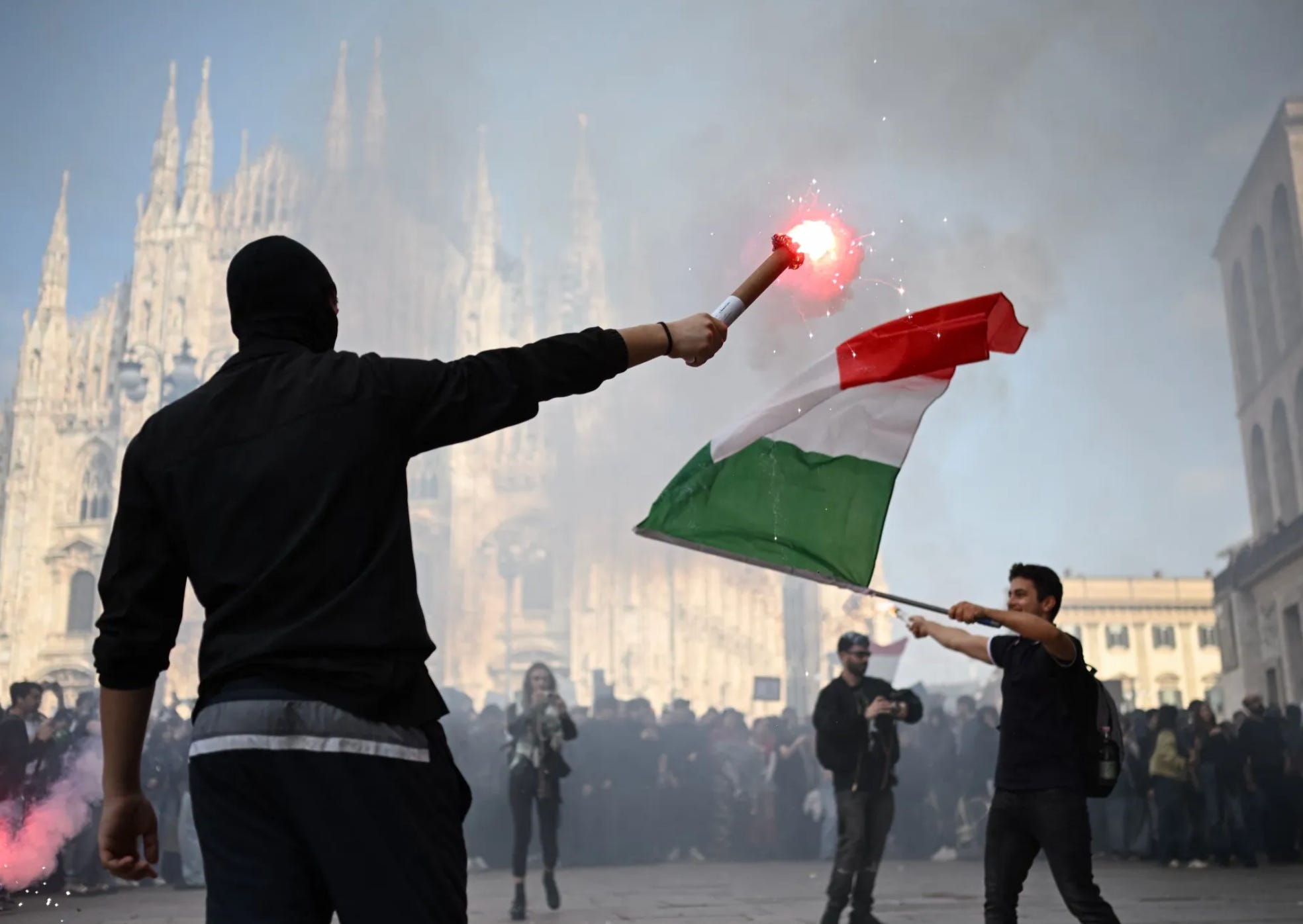
During the first riot in Milan, I was working in Rome for an art exhibition - I came back the day after and could not recognize the Duomo area, as it was vandalized and destroyed. There were helicopters in the sky, ambulances around the corner, no cars driving on the streets, plants thrown to the ground, and sidewalks covered in soil and trash bins emptied. Museum doors were broken. The Duomo had a large fire in front of it. I can see why an American seeing this apocalyptic scenery in Europe and the so-called “maranza” - the young immigrant delinquents - in videos burning the city to the ground would think the invasion by foreigners is reaching its apex, and that this is all the issue is about. However, the truth is that these criminal migrants (many of whom are second- or third-generation immigrants) began acting after the protests unfolded. Like sharks in the water, they smelled blood. They sensed a power vacuum and used it for their own ends: To destroy and steal what they could while the contract between the citizens and the government was broken. Meanwhile, the true reason for the uprisings was ignored.
In Italy, the protests came from a variety of places. A few days before the violence unfolded, southern European truck drivers and farmers were protesting by blockading the streets because of rising fuel prices, which are now almost 3 Euros per liter (the equivalent of almost 12 Dollars a gallon; even the highest rates in America only reached 6.5 Dollars a gallon). If fuel in America cost 12 Dollars a gallon, it would contract the economy into such a recession that it would lead to widespread popular upheaval. American farmers and truckers would probably be marching on Capitol Hill with guns. Please type into your Claude account: “What would happen to the US if the price of fuel rose to 12 Dollars per gallon?” And see the response. This is the type of analysis AI can be useful for.
We sometimes forget how our entire supplies depend on fuel. I certainly forgot this since I don’t know how to drive and use public transport every day, and the price of fuel to me was the most irrelevant thing I could think of. It became relevant when inflation started reaching unsustainable levels. I heard why these truck drivers and farmers were protesting, how supermarkets began emptying, and how livestock began going hungry because farms were no longer receiving the transport of food, and they had reserves for only two days. It became relevant when I heard about pharmaceuticals not reaching hospitals. This is how important fuel is; it transports goods for our most fundamental needs. If the price of fuel rises to such an extent, so do those supplies, which is why a loaf of bread now costs around 5 Euros a kilo, so almost 3 Dollars per pound (it is currently almost half that price in America). Seeing supermarkets in the south of Italy emptying, I started preparing for a shortage of food in my apartment, and so do many Italians I know. The fact we have somehow normalized living in a reality so doom-laden since Covid means we have forgotten to demand more from our ruling class.
The price of fuel depends on where the fuel comes from. European economies largely depended on Russian gas; that ended with sanctions on Russia for the war in Ukraine, while we continue to send billion-dollar packages to Ukraine to defend itself against an endless war that it could never sustain without being propped up by the EU and US war machine. The US war on Iran added another shockwave to the supply of oil through the bottleneck over the Strait of Hormuz, which carries a fifth of the world’s oil supplies. Now it’s simply a chokehold. Feeding our people must come first.
Then you had the student protests, led surely by naive young progressives and Gen Z utopians who are, however, extremely aware of how their future has been robbed in front of their eyes. For some perspective, the average Gen Z or Millennial who finds a job gets paid around 1,500 a month. Of such a modest salary today (which is, however, an average one in Italy), 700 dollars are spent on rent for a room with three strangers, 350 in utilities because of soaring energy prices, 500 euros on groceries because of inflation, and the rest on rising fuel or public transportation costs to commute - not to mention the heavy taxes that must first be paid on that salary, which can reach up to 45%, while public infrastructure is crumbling. So an average salary does not cover a single person’s livelihood, nor does that young person see any tangible benefit in return.
Meanwhile, the Baby Boomer generation is still living off wealth they’ve extracted through mere fortune during the greatest economy in world history and still own the majority of the property market with vast appreciation while destitute youngsters pay for their pension system. The majority of Gen Z and Millennials cannot dream of entering this property ladder while they are left to fend for themselves in such a devastating economy, abandoned by their narcissistic parents who simply tell them, “I made it on my own, now it’s your turn.”
It is for these reasons that younger generations are no longer having families, and the situation is getting worse. When I explain that this has nothing to do with women entering the workforce because Italy has one of the lowest female participation rates in the workforce in the EU (barely half of women work), while having the lowest salary growth, this causes cognitive dissonance in right-wingers who bet their ideology on scapegoating feminism. I explain to them that third-world nations have more children than ours even if they’re poorer because the cost of living is proportionately lower, and because having children is a benefit rather than a cost, as those children provide more labor and security to the family. I also explain that these families support one another through an extended network, sharing burdens and responsibilities (being immune to the disease of the Western Boomer, who couldn’t wait for their children to leave the home and is horrified at the idea of having grandchildren to care for). This is also why immigrant communities in the West are growing so rapidly. When I explain these factors, right-wingers tend to react with defensiveness. However, sincerity requires stating the truth, no matter how uncomfortable it may feel, and admitting when your previous convictions were wrong. That is one of the surest signs of intelligence.
After these two demonstrations of popular discontent, the migrants entered the picture. Of course, their violence is convenient for the right-wing government for two reasons. First, it’s a rhetorical tool to distract from the real crisis that shows just how much their leadership failed. Second, it justifies employing extensive security measures against any form of dissent under the guise of “order”. No distinction was made between natives and migrants in the security decree announced by Meloni on October 22 in the aftermath of the protests. Everyone was painted with the same broad brush, except vague appeals to “peaceful vs. violent protests”. There was no talk about remigration or repatriation for those migrants despite them committing half of the violence. It was a blanket decree where anyone involved in violence could face up to five years in prison with more punishment if someone covered their face. Even minors now face criminal charges, with parents having to pay up to 20,000 Euros in fines for the actions of their children. That would almost wipe out an entire family’s savings, as if they weren’t suffering enough. To be clear, such decrees are so broad that even being close to a group of migrants committing violence during such chaos could be seen as you being complicit, despite how the government refuses to implement remigration measures. Truckers and farmers who block roads can now see their vehicles confiscated, as if you can whip a dying mule to work harder.
These measures represent a perfect recipe for the government to remain in power a little longer and approve the last package of military support to Ukraine and, as Meloni’s term nears its end, for her new parliamentarians to be guaranteed a state pension for life. Meanwhile, her people are no longer holding their heads out of water. And a reminder for those who have amnesia that it was her government that promised an end to mass immigration with repatriations and a hardline stance against Islamism, while it approved the entry of half a million new immigrants from outside Europe. She said her government saw a million new jobs being created, conveniently omitting how almost half of those were from this supply of foreigners to the labour market.
It’s important to note that while the students in Milan and Turin tend to be progressives, the truck drivers and farmers in southern Italy are largely right-wing and voted for this government. This represented a unique opportunity for the people of the country to come together, if it weren’t for the foreigners who acted as agents of chaos. Migrants have become the perfect scapegoat for the right-wing, which refuses to address the economic plight of ordinary citizens, serving as an easy win for progressives. In fact, most people feel unrepresented by the Right on the economy, and unrepresented by the Left on immigration.
Italian citizens in general are far from the kind of people who organize riots like the French. For them to be blockading roads and mobilizing on the streets means that the discontent is severe and profound.
Both immigration and the cost of living are leading to Europe’s demise. Addressing only one at the expense of the other wouldn’t stop the train from traveling on that railroad. Both must be addressed for Europe to be saved. There is no Left or Right in any meaningful sense anymore; this is merely another divide-and-conquer trap by our elites. Seeing right-wingers patrol the streets to guarantee safety is part of the plan for new guerrilla warfare to unfold among citizens while the government emerges as the savior and the status quo continues unabated. The debate today is about our survival. The ruling class wants you to think it’s about us fighting each other. Change only takes place when our voice can no longer be ignored. We need that change, and our chance is now.
I am a Canadian Gen X-er and I have deep sympathy for young people in North America and Europe who have literally no way to access a decent life without substantial family help or luck. The math doesn’t add up.
My view is that the Baby Boomers got a deal, Gen X got a worse deal, the Millennials thought they were getting a deal but weren’t, and the Zoomers know they aren’t getting a deal. I think it’s far more honourable for Zoomers to struggle for a decent life than living a life of obedient drudgery.
I think that Generation X is livid and wants change. I find Boomers utterly oblivious, self absorbed and unwilling to engage with new information. You just get the Boomer stare.
The right wing outrage industry is utterly stale at this point, just feel good pats on the back for the out of touch. New voices and a totally new approach are required.
If young people can’t access a decent life and start a family, that is the true national emergency, not the Ukraine.
Another great article written by you. You’ve articulated these complexities with such clarity and nuance, something missing from much of our political discourse. I often wonder how much Americans, on both the left and the right, might learn from one another if we could step outside the confines of identity politics and ideological tribalism long enough to recognize how much we actually have in common. We’ve become so invested in identifying who is on the opposing side that we’ve lost sight of the shared frustrations, concerns, and aspirations that transcend political affiliation.